Ed Hardy is a time capsule you can still buy new. Whether that’s a feature or a bug depends on how you feel about 2006.
Men’s Ed Hardy jeans are either ridiculous or exactly what you want, with very little middle ground. The brand is experiencing a real Y2K revival that’s pulled it back from thrift-store-only into actual current retail, and the jeans themselves are made better than the reputation suggests. This guide covers what the brand sells now, fit and sizing realities, graphic durability, and whether wearing Ed Hardy today reads vintage-cool or costume. Pillar at Men’s Denim and the broader 2000s revival context at Men’s Baggy Jeans 90s.
What Ed Hardy is today
Ed Hardy is based on the tattoo art of Don Ed Hardy and was the hottest fashion brand in America between 2005 and 2009 before collapsing under the weight of its own market saturation. After multiple dormant years and ownership changes, the brand has been steadily relaunching since roughly 2020 with a mix of vintage-style reissues and new pieces that lean into the 2000s Y2K aesthetic currently back in fashion. Jeans retail at $80 to $150 direct and show up regularly on Amazon and secondhand. The brand has moved from trying to be the hottest label to embracing its specific retro niche.
The graphic approach
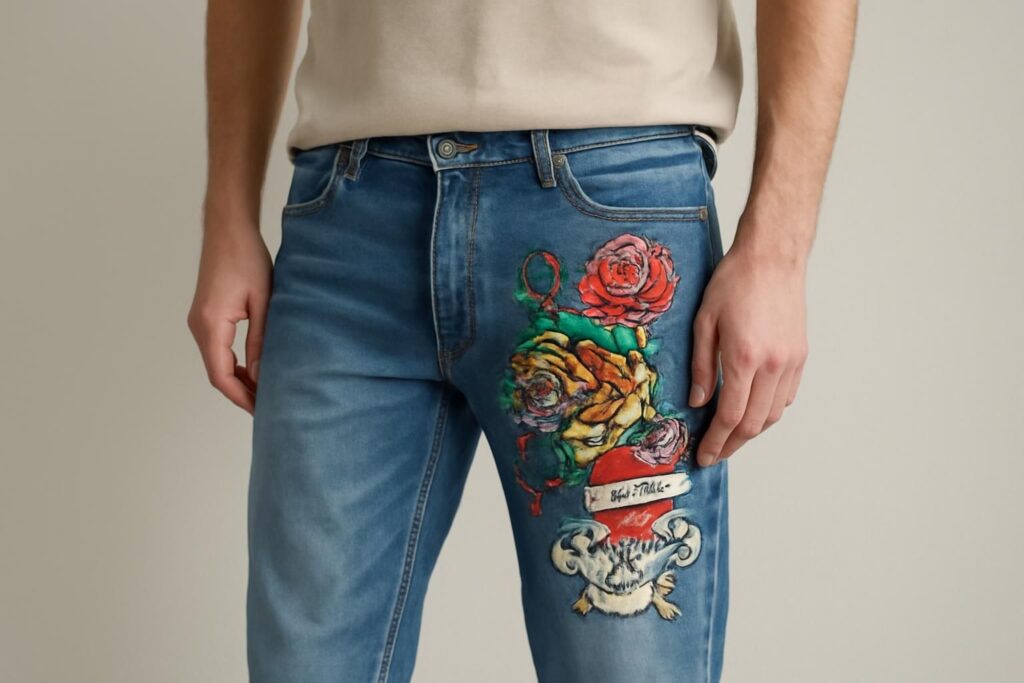
Ed Hardy jeans fall into three visual tiers. One: subtle back pocket logo or small embroidered tattoo art on an otherwise clean jean. Two: prominent back pocket graphics (the famous cross, skull, rose, tiger, or koi designs) in dense embroidery. Three: full-leg graphic treatments with painted or printed tattoo art running down the thigh or calf. Tier one reads as a subtle 2000s callback. Tier two reads as an intentional commitment to the aesthetic. Tier three is costume territory unless you’re genuinely fully committed to the Y2K look. Most Ed Hardy buyers land on tier two — noticeable back pocket design, otherwise normal jean.
Fit and sizing
Ed Hardy’s sizing can be inconsistent across production runs, which is a real ongoing issue: a tagged size may measure slightly bigger or smaller than the label at the waist and thigh. Before ordering, ask the seller for flat measurements or compare the listing’s size chart against a pair you already own. The classic silhouette is an honest 2000s-era bootcut — full through the thigh, distinct kick from the knee down, hem that breaks deep over a shoe. For anyone sizing into Ed Hardy for the first time, buy from a seller with good returns and expect some variance. Try multiple pairs if possible at a brick-and-mortar retailer.
Fabric quality
Current Ed Hardy jeans are typically a cotton blend with a small percentage of stretch; check the listing for exact composition. The fabric is mid-tier — not premium raw denim but generally better than fast fashion. The denim isn’t the selling point here; the graphics are. But the underlying jean is wearable, and cotton-stretch denim like this softens predictably with washing.
Graphic durability
Graphic durability is the biggest question for most buyers. Dense embroidered back pocket designs tend to hold up well, and heavy thread work can even reinforce the pocket rather than weaken it. Printed or painted graphics (tier three designs) are where durability questions get real — the print can crack or fade after repeated washing. For printed pieces, cold wash inside out is mandatory to preserve the art. For embroidered pieces, standard care works fine.
How to wear Ed Hardy without full costume
The trick is treating Ed Hardy like a single statement rather than an outfit theme. An Ed Hardy bootcut with a clean fitted tee and minimal accessories reads as an intentional nod to a specific era. Ed Hardy jeans paired with an Ed Hardy shirt, a trucker hat, and a graphic-heavy jacket is a costume. One Ed Hardy piece per outfit, the rest neutral and fitted, is the modern approach. Footwear: skate sneakers, Air Force 1s, or clean leather boots. Avoid dress shoes and cowboy boots (both clash with the 2000s streetwear context).
Who Ed Hardy works for today
Y2K revival shoppers who want an authentic brand rather than a new brand copying the 2000s aesthetic. Men already dressing in 2000s streetwear (low-rise, bootcut, graphic-heavy tops) who need the jean to match. Collectors and vintage-rock scene participants. Anyone wearing Ed Hardy with irony as a deliberate style choice — which reads as genuine commitment within the current scene’s rules. Not: men looking for versatile jeans that work across contexts. Not: workplaces with dress codes. Not: quiet-luxury or minimalist dressers.
Ed Hardy compared to other revived 2000s brands
Ed Hardy sits in a specific niche. Affliction is similar territory — graphic tees and jeans with tattoo-inspired design, currently experiencing similar revival. True Religion is the more polished cousin — graphic back pockets but more sophisticated designs. See Men’s Black True Religion Jeans. Rock Revival plays in the same premium-casual space with denser embroidery. See Men’s Rock Revival Jeans. Von Dutch and Evisu are the European and Japanese counterparts to the 2000s streetwear revival. Ed Hardy’s specific selling point is the tattoo-art aesthetic; other brands split the other features.
Vintage vs new
Vintage Ed Hardy from 2005 to 2009 shows up regularly on eBay, Poshmark, and Grailed. Prices run $40 to $150 depending on design, fit, and condition. Fabric on some original-era pieces is noticeably better than current production — pre-2009 Ed Hardy used denser cotton and more detailed embroidery. For the aesthetic specifically, vintage pieces often have more character. For a wearable everyday pair, current production is more reliably sized and better preserved. Browse vintage at Ed Hardy Jeans Mens on Poshmark, current at Ed Hardy Mens Jeans on Amazon. Related brands at Shop on Amazon.
The verdict
Men’s Ed Hardy jeans are reasonably made Y2K revival denim for buyers committed to the aesthetic. Fabric is decent, embroidered graphics are the more durable option, and fit is inconsistent across production runs but workable. The brand isn’t trying to be universal; it’s aggressively targeting the 2000s revival shopper. If that describes you, Ed Hardy delivers. If you’re unsure whether the aesthetic is your speed, buy a vintage pair from Poshmark for $50 before committing to retail — you’ll know after a week whether you own the look or the look owns you.
Shop the look on Amazon
Everything you need to build a secondhand-style wardrobe, delivered. We may earn a commission on purchases.
FAQ
Are Ed Hardy jeans still made?
Yes. The brand has been actively manufacturing and selling since roughly 2020 after earlier dormant periods.
Are Ed Hardy jeans good quality?
Fabric is mid-tier, construction is solid, and embroidered designs are more durable than printed ones. Not premium, but not cheap. Fair for the $80 to $150 retail price.
Do Ed Hardy jeans run true to size?
Sizing is inconsistent across production runs. Expect some variance in the waist and length. Buy from sellers with good returns.
Is Ed Hardy back in style?
Within the Y2K revival scene, yes. In mainstream fashion, it remains a niche brand. Whether it’s “in style” depends heavily on which circles you’re dressing for.
Why is Ed Hardy trending again as a fashion brand?
Ed Hardy is trending again because the Y2K revival has pulled the brand back from thrift racks into current retail. After dormant years and ownership changes, it has been relaunching since roughly 2020 with vintage-style reissues and new pieces that lean into the 2000s aesthetic. The current way to wear it is as a single statement piece, such as a back-pocket graphic bootcut with a clean fitted tee, rather than a head-to-toe logo outfit.