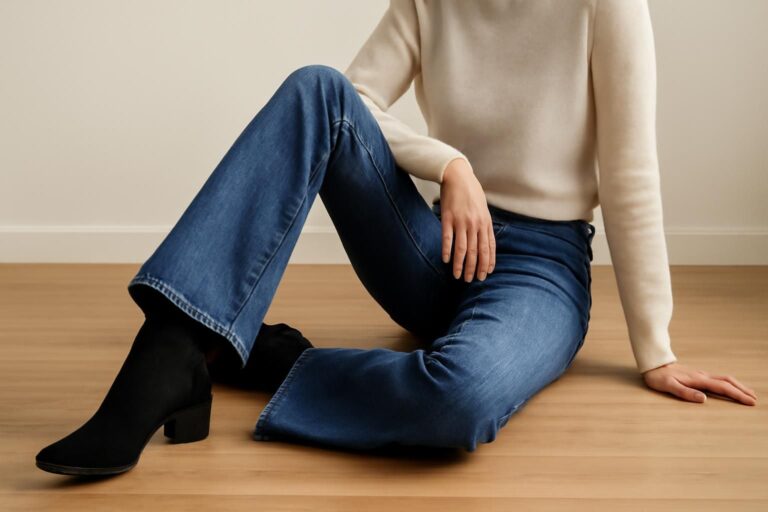
2000s baggy is not the same as the current super-baggy revival. The rise was lower, the leg was straighter through the thigh before flaring out, and the wash was almost always whiskered to within an inch of its life.
If you grew up watching MTV’s TRL between 2001 and 2005, you remember this silhouette. Cargo pockets, low-rise waist, whisker-stitched thighs, and a hem wide enough to puddle around skate shoes. South Pole, JNCO, Diesel, Apple Bottoms, Rocawear, every brand on every billboard was selling some version of it. The current super-baggy revival looks adjacent but isn’t the same cut. This piece walks through what made 2000s baggy distinct, where to find authentic vintage in 2026, and how to style it without slipping into era-cosplay. The broader Denim Styles guide covers other silhouettes if you’re not committed to the throwback.
What made 2000s baggy a specific cut
Three details. First, the rise. Front rise sat between 7 and 9 inches, which puts the waistband below the navel for most bodies. Today’s super-baggy runs 11 to 13 inches at the front rise. The visual difference is huge, 2000s baggy shows hipbone, modern baggy hits the natural waist or above.
Second, the leg shape. 2000s baggy ran straight or slightly slim through the thigh, then opened up below the knee. Almost a reverse silhouette to today’s relaxed-from-the-hip baggy. Third, the surface treatment. Whisker stitching at the hip-thigh fold was nearly universal, often with sandblasted thigh fades and frayed hems from the start. Modern baggy tends to ship clean. If you’ve read Baggy Y2K Jeans, the Y2K subset covers the wider, more JNCO-skewed end of this same era.
Vintage hunting in 2026
Authentic 2000s baggy is on resale, not in stores. Depop, eBay, Grailed, and Etsy vintage sellers all carry the era. Search terms that surface real pieces: “South Pole 2003,” “JNCO 23-inch,” “Diesel Zatiny 2002,” “Rocawear baggy,” “Apple Bottoms low rise.” Pricing has crept up, what cost $25 in a Buffalo Exchange in 2018 now goes for $60 to $150 on Depop, more if the brand is collectible.
JNCO is its own market. Original 2000s JNCOs in clean condition fetch $120 to $300 depending on the leg width and wash. The JNCO reissue line that launched in 2024 sits closer to $80 to $130 retail, and the cut runs faithful to the original 2000s spec. Diesel archive drops have been pulling back specific 2002 to 2005 styles in limited runs, priced at $200 plus. If you want the look without hunting, 2000S Baggy Jeans Women Low Rise on Amazon returns a mix of reissues and contemporary low-rise baggy that gets close. Vintage sizing runs all over the place, measure the waistband flat and add 1 inch for stretch, or buy from sellers who post a tape-measure photo.
Wearing 2000s baggy in 2026
The trap is wearing 2003 head to toe. Trucker hat, studded belt, baby tee with rhinestone graphic, the whole MySpace look. Same rule as Y2K flare, pick one era element and let the jeans carry the rest. A clean way to wear vintage South Pole is with a fitted black ribbed tank, a single thin belt, and either Sambas or a Chelsea boot. Modern footwear modernizes the silhouette without erasing it.
For tops, the original 2000s call was a baby tee or a logo crop. In 2026, swap that for a fitted ribbed knit, a tucked button-down, or a slim turtleneck. The contrast between a fitted top and the wide low leg is the look, go oversized on top and you’ve lost the 2000s reference entirely and slipped into modern super-baggy territory, which is a different aesthetic. For winter, a slim leather jacket over the same fitted top reads more 2026 than a puffer would. If you want oversized on top, look at How to Style Baggy Jeans (Without Looking Like You Tried Too Hard) for the modern baggy approach instead.
Footwear that works with 2000s baggy
The original era footwear was skate shoes, DC, Etnies, Vans Old Skool, and chunky Air Force 1s. All of those still work in 2026 because they’re in their own revival cycles. Sambas, Cortez, and Air Force 1s pair cleanly. For boots, a Chelsea like a Blundstone or Doc Martens 2976 anchors the wide hem without competing. Cowboy boots under wider 2000s baggy reads great in a Western-leaning outfit; see Chelsea Boots with Baggy Jeans for the specific Chelsea pairing breakdown.
What doesn’t work: ballet flats and pointed flats disappear under the wide hem and the proportion reads off. Stilettos make the leg look heavier than the body, the opposite of the era intent. Mid-volume runners like Hokas or chunky New Balance 9060s end up competing with the hem for visual mass. The general rule is the same one in Shoes for Baggy Jeans, match the hem-to-foot proportion, lean structured rather than delicate.
For every styling guide in one place, see: Denim Styling Trends: The Complete Guide
The verdict
2000s baggy is its own silhouette, distinct from the current super-baggy wave. The rise is lower, the thigh is straighter, the hem treatment is whiskered. Buying authentic means hunting vintage on Depop and eBay, with JNCO and Diesel commanding the highest prices and South Pole or Apple Bottoms more accessible at $40 to $100. JNCO reissues from 2024 onward are the closest current production option. Style with one era element and modern accessories, a fitted top, structured bag, contemporary boot or sneaker, and the silhouette reads as intentional revival rather than costume. For the related Y2K cuts, Baggy Y2K Jeans covers the wider JNCO end and Y2K Flare Jeans covers the bell-bottom side. If you’re shopping current rather than vintage, Are Baggy Jeans in Style? Where the Trend Stands in 2026 covers the 2026 baggy market.
Shop the look on Amazon
Everything you need to build a secondhand-style wardrobe, delivered. We may earn a commission on purchases.
Browse picks on Amazon →FAQ
What’s the difference between 2000s baggy and Y2K baggy?
They overlap heavily. Y2K is the broader era label (1999 to 2004), and 2000s baggy is the specific cut from that era, low-rise, straight thigh, wide hem, whiskered. Most Y2K baggy is also 2000s baggy. The terms get used interchangeably in resale listings.
Are JNCOs coming back?
JNCO relaunched in 2024 with a reissue line that runs faithful to the original 2000s spec. Original vintage JNCOs from 2000 to 2005 are also back on resale at $120 to $300 depending on leg width. The brand’s 23-inch and wider cuts are the most collectible.
Can you wear 2000s baggy jeans high-rise?
No, the defining feature is the low rise. Pulling the waistband up past the natural waist changes the silhouette to a generic baggy and erases the 2000s reference. If high-rise is what you want, look at modern relaxed-straight or current super-baggy cuts instead.
How do you spot authentic 2000s baggy jeans when shopping resale?
Authentic 2000s baggy jeans have a low front rise of roughly 7 to 9 inches, a leg that runs straight or slightly slim through the thigh before opening below the knee, and heavy whisker stitching at the hip-thigh fold, often with sandblasted fades. Modern revival pairs sit higher and usually ship clean. On Depop, eBay, Grailed or Etsy, search era brand names such as South Pole, JNCO, Diesel or Rocawear, and favor sellers who post a tape-measure photo.