
Mom Jeans: Honest Take on Fit, Rise, and Whether They Are Worth It
Mom jeans have been mocked, reclaimed, overmarketed, and diluted to the point where the term barely means anything anymore. I am going to fix that.
I have owned mom jeans for the better part of a decade — real ones, not the skinny jeans with a high waist that brands kept relabeling in 2017. Over nine weeks I wore six pairs from different brands and price points, tracking which ones I kept reaching for versus which ones stayed folded in the drawer. This guide is part of the larger Denim Styles hub, covering one of the most searched and most misunderstood silhouettes in women’s denim.
What are mom jeans, really
Mom jeans are a high-waisted, relaxed-fit jean that sits at or above the natural waist, has ease through the hip and upper thigh, and tapers to a narrower leg opening at the ankle. That taper is the defining feature. It separates mom jeans from every other relaxed silhouette.
The name carries baggage. The 1990s SNL sketch turned “mom jeans” into a punchline — shapeless, unflattering, nine-inch zipper, faded to oblivion. That version was a real thing. My own mother wore them. But the modern mom jean is a different garment. The rise is still high, but it is proportioned to current body shapes rather than cut from a 1988 pattern block. The thigh has relaxed room without excess billowing. The taper from knee to ankle is more gradual, ending at a 13-to-15-inch leg opening rather than the aggressive 11-inch pencil taper of the originals. And the washes have moved well beyond acid-bleached light blue.
The silhouette is closest to Boyfriend Jeans, but mom jeans are more structured. Boyfriend jeans slouch through the hip and have a borrowed-from-someone-bigger looseness. Mom jeans have intentional room through the hip and thigh but keep a defined, fitted waistband. They are also distinct from Baggy Jeans for Women, which maintains width from hip to hem without any taper. And they share the high waist with High Waisted Jeans, but mom jeans add relaxed volume where high-waisted skinnies or straights would cling.
How mom jeans should fit: the three checkpoints
I have tried on hundreds of pairs over the years. The difference between a mom jean that looks intentional and one that looks like you gave up comes down to three specific fit points.
The waist and rise. Mom jeans should sit at your natural waist — the narrowest part of your torso, usually an inch or two above your navel. The rise on a proper mom jean is 11 inches minimum, with most landing between 11.5 and 12.5 inches. If the rise is under 10.5 inches, the brand is calling a mid-rise jean “mom” for marketing purposes. The waistband should be snug without digging — one finger between band and skin, not a fist. A loose waist means the jean slides, and a sliding mom jean looks frumpy fast.
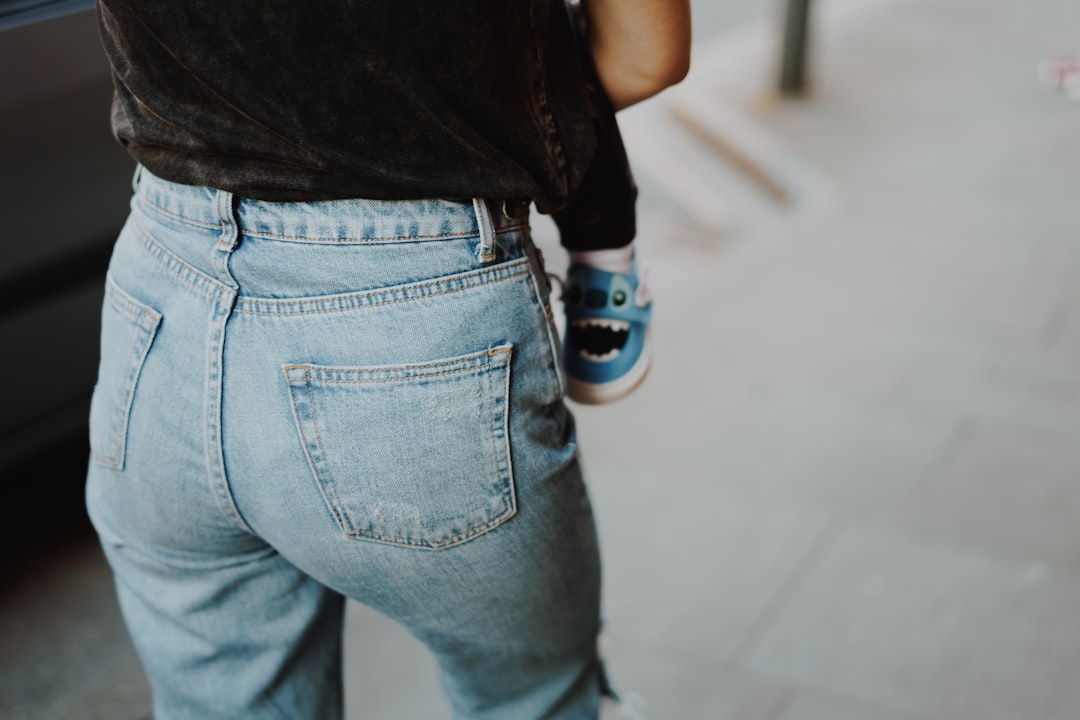
The hip and thigh. This is where mom jeans earn their name. There should be visible ease — enough room that the fabric does not pull across your hip bones or stretch across your upper thigh when you sit. But “ease” does not mean “excess.” I can pinch about an inch of fabric at my outer thigh on a well-fitting mom jean. More than two inches and the jean starts to look like it belongs to someone else. The back pockets should sit centered on the curve of your backside, not below it. Drooping pockets destroy the proportions of this silhouette instantly.
The taper. From the knee down, the leg should gradually narrow. Not aggressively — this is not a jogger. But a size 27 mom jean should have a leg opening between 13 and 15 inches. If the opening is wider than 16 inches, you are looking at a straight-leg or a wide-leg that has been mislabeled. The taper is what gives mom jeans their slightly vintage, slightly polished shape. It is non-negotiable.
Sizing: the most common mistake
People size up in mom jeans because they are afraid of a snug waist. Do not do this. A mom jean one size too big loses structure at the waist, the pockets drop, the crotch sags, and the taper hits at the wrong point on your calf. The entire silhouette falls apart.
Buy your true waist measurement. The hip and thigh are already cut with room built in. You do not need to add more.
For reference: I am 5’6″, 28.5-inch natural waist, 38-inch hip. I wear a 27 in Levi’s, a 27 in Agolde, and a 28 in Kancan Jeans Review (Kancan runs about a half size small in their mom fit). In Judy Blue Jeans mom jeans, I was a true 7 (equivalent to a 28), and the fit through the hip was the most generous of any brand I tested.
High waisted mom jeans vs. mid-rise: there is only one right answer
A mom jean with a mid-rise is a contradiction. The high waist is structurally essential — it creates the long-leg proportion that offsets the relaxed volume in the hip and thigh. Drop the waist to mid-rise and the relaxed thigh just looks loose, not intentional. I tried mid-rise jeans marketed as “mom” from three brands, and none of them read as a mom jean. They read as a slightly baggy mid-rise straight.
Look for a rise of 11 inches or higher. The sweet spot was 11.5 to 12 inches. Above 13 inches starts feeling like paper-bag trousers. For more on how rise affects every silhouette, High Waisted Jeans breaks it down across all the major cuts.
Black mom jeans, ripped mom jeans, and how wash changes the vibe
The wash you choose transforms what mom jeans communicate.
Medium vintage blue is the default. It is the most “mom jean” looking wash — the one that connects most directly to the 90s original. It pairs with everything and reads as casual-cool. Most of my wear time was in this wash because it required the least thought.
Black mom jeans are the dressiest option and my personal favorite for going out. Black denim in a relaxed silhouette feels intentional in a way that light washes sometimes do not. The taper reads cleaner in black. The high waist pairs naturally with a tucked silk camisole or a fitted black top for a tonal look that works for dinner, not just brunch. If you only buy one pair, I would argue for black over blue.
Light wash leans hardest into the vintage aesthetic. It is the most casual option and the hardest to dress up. Light-wash mom jeans with a white tee and sneakers is a uniform I respect, but it caps out there.
Ripped mom jeans work when the distressing is restrained — a single knee rip or a couple of small holes. The relaxed thigh already has a lot of fabric surface area, and heavy shredding across that much denim looks chaotic. One or two placement rips. Less is significantly more.
Pairs I wore: honest notes
Six pairs, nine weeks. Here is what I found.
Levi’s 80s Mom Jean — $98
The benchmark. 100% cotton, 12-inch rise, 14-inch leg opening, proper taper. Stiff for the first four days, then broke in beautifully. The back pockets are placed high, which is flattering. After six washes the inseam lost half an inch and the waist tightened — both improvements. This is the pair I wore most often.
Agolde 90s Mid Rise — $198
Agolde calls this “mid rise” but it measures 11 inches, which is high-rise by any standard. 100% organic cotton, exceptional weight, beautiful drape. The 15-inch leg opening gives it a more modern, less vintage taper. At $198 I am not sure it does enough more than the Levi’s to justify the price.
Judy Blue Mom Jean — $58
Most comfortable from day one. The stretch blend (2% spandex) meant zero break-in, and the 11.5-inch rise sat perfectly. Downside: the knees bagged out by end of day, though three washes reset the shape. Best value if you prioritize comfort. Browse options at Judy Blue Mom Jeans Women on Amazon.
Kancan Mom Jean — $52
Runs small in the waist but generous in the hip. The 13-inch leg opening was the narrowest in the test — almost skinny territory. Too aggressive a taper for my taste, but if you want that 90s-authentic narrow ankle, Kancan delivers.
Amazon — Lee Riders Mom Jean — $28
Genuine surprise. 11.5-inch rise, 99% cotton with 1% spandex, properly proportioned taper. Lighter denim (9 oz) and less refined stitching than Levi’s, but for $28 this is a real mom jean. Check Lee Riders Mom Jeans Women on Poshmark for secondhand pairs.
Thrifted Levi’s 550 — $12
The original mom jean, literally. Vintage 550, 100% cotton, 12.5-inch rise, real tapered leg, properly faded from years of wear. The front pleats — which modern brands have eliminated — add volume at the hip I actually liked. Vintage is still the best way to get a real mom jean.
Styling: what I have learned from years of wearing these
Mom jeans are the most versatile relaxed silhouette in denim. They dress up and down more easily than Wide Leg Jeans (which leans dressy) or Straight Leg Jeans (which can read too plain without effort). Here is what I reach for.
Tucked-in tees. The high waist was designed for tucking. A fitted crew neck tucked in, with or without a belt, is the cleanest everyday combination. The waist is visible, the taper is visible, and the proportions balance without trying. Crop tops and bodysuits that end at or above the waistband work the same way — the high rise eliminates any skin gap.
Blazers. A structured blazer over a fitted top with mom jeans is a look I wear to meetings. The blazer adds formality, the jeans keep it grounded, and the taper means the ankle is visible for heels or loafers.
Shoes. White sneakers are the default. Loafers dress them up one notch. Heeled mules or slingbacks take them to dinner. Ankle boots work in fall and winter — the tapered leg sits neatly over a boot shaft without bunching. Avoid slides and flat sandals; the narrow hem wants a shoe with some structure.
The verdict
Mom jeans deserve their place in the rotation. Not because they are trendy — the trend cycle has already chewed through them and moved on to barrel jeans and wide legs — but because the silhouette is genuinely comfortable, genuinely versatile, and genuinely flattering when it fits right. The high waist does real work. The relaxed hip and thigh are functional, not just aesthetic. The taper keeps them from reading as shapeless.
Buy the Levi’s 80s Mom Jean for the benchmark in rigid denim. Buy the Judy Blue for comfort from day one at a fair price. Thrift a pair of vintage 550s for the real thing at the cost of lunch. Size true to your waist. Go high-rise only. And stop apologizing for wearing them — they are called mom jeans, not a character flaw.
Shop the look on Amazon
Everything you need to build a secondhand-style wardrobe, delivered. We may earn a commission on purchases.
FAQ
What is the difference between mom jeans and boyfriend jeans?
Mom jeans have a high waist (11-12 inch rise), structured waistband, relaxed hip and thigh, and a tapered leg that narrows at the ankle. Boyfriend jeans sit lower (9-10 inch rise), have a slouchy fit everywhere including the waistband, and taper less. Mom jeans look intentional. Boyfriend jeans look borrowed.
Are mom jeans still in style in 2026?
Mom jeans peaked around 2020-2022 and the trend conversation has moved toward barrel jeans and wide legs. But mom jeans are a permanent denim silhouette — like straight-leg or bootcut — that will always be available and always look right when they fit properly. They do not need a trend cycle to justify wearing.
Should I size up in mom jeans?
No. The hip and thigh already have extra room built in. The waist needs to fit snugly to hold the silhouette together. Sizing up loosens the waist, drops the pockets, and makes the whole jean look wrong. Buy your true waist measurement. If a brand runs small, go up one to match your actual waist — but you are sizing to fit, not to add room.
Can you wear mom jeans to work?
In most business-casual environments, yes. A dark wash or black pair with a tucked-in blouse or blazer reads polished enough for any office that allows denim. Avoid distressed pairs, light washes, and heavy cuffing. Keep the shoes elevated — loafers, low heels, clean leather boots — and the jeans disappear into the outfit.
What body type do mom jeans look best on?
They work across body types because the high waist elongates the leg and the relaxed hip accommodates curves without squeezing. They are particularly effective on pear and hourglass shapes. The silhouette is hardest to fit on very short torsos (where the rise feels overwhelming) and petite frames with standard inseams (where the taper hits wrong). Both issues are solved by petite-specific cuts or a rise under 11.5 inches.


