
Learning to identify vintage Levi’s in under ten minutes is the single highest-ROI skill in denim shopping. It saves hundreds in overpayment, catches fakes before money changes hands, and lets you score thrift pieces that untrained eyes walk past.
I’ve taught this process to four friends at this point, and the pattern is the same every time: they’re intimidated at first because collector forums make it sound impossibly complex, and then within an hour they’re dating pairs to within a decade confidently. The complexity is overblown. Here’s the real process. Our Vintage Levi Tag Identification piece goes deeper on tags, and the Brand Guides hub covers the pillar.
The three-minute authentication stack
Before buying any pair, check:
1. Red tab: Big-E (capital E) or small-e (lowercase e)? This alone tells you pre-1971 or post-1971.
2. Care tag: Made in USA?
3. Waistband patch: Present, readable, consistent with era claim?
4. Inner inseam: Redline selvedge visible?
5. Fabric weight and hand: Heavy and dense, or light and thin?
That’s the five-point check. Three minutes if you’re practiced, ten minutes if you’re new. Skip any of these and you’re guessing.
Check 1: the red tab
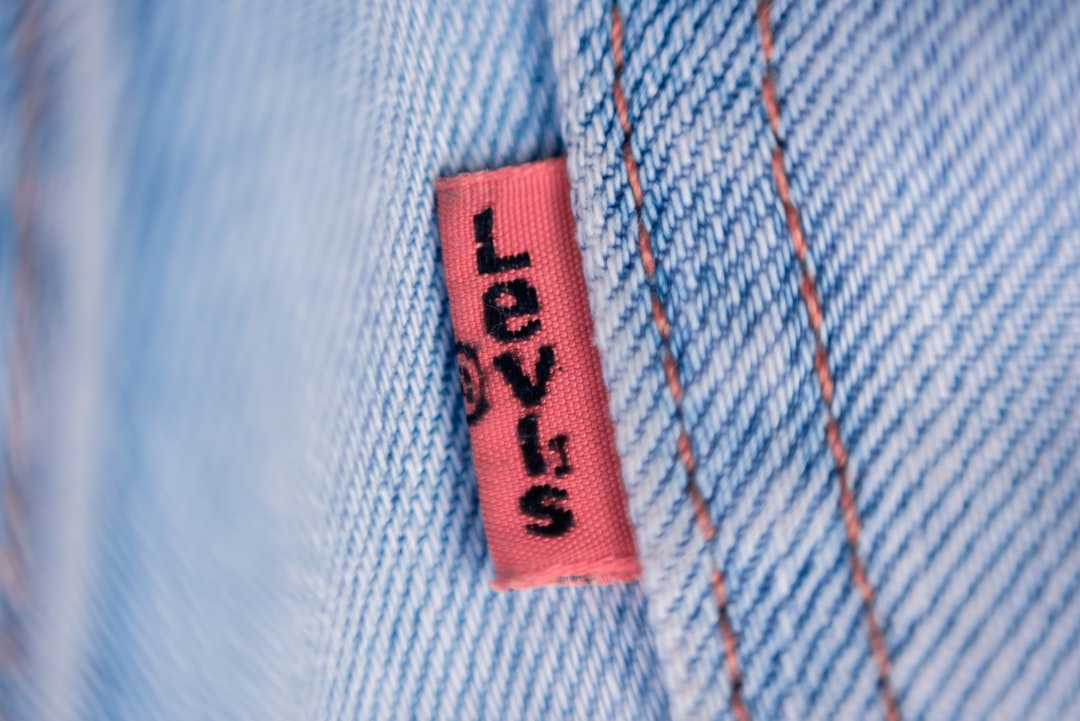
The red tab is the fastest read. Pull the back pocket out so you can see the tab clearly. Look at the “E”:
Big-E (“LEVI’S”): Pre-1971. Rare post-1970. Commands premium prices.
Small-e (“Levi’s”): Post-1971. The bulk of vintage 501s on resale.
Also check:
Tab color: Red = 5-pocket mainline. Orange = fashion-oriented lines (519, 646, 684, others). Silver = 90s Silver Tab. Each signals a different product family.
Tab condition: Should show age. Fraying and fading normal. A pristine red tab on an otherwise distressed pair is suspicious.
Tab stitching: Factory stitching pattern should be consistent. Re-stitched or replaced tabs have different thread color or stitch density.
Check 2: the care tag
Care tags are the richest source of dating information. Check:
Country of origin: Made in USA = pre-2003 for 501s (later cutoff varies for other lines). Any non-USA country = not traditionally vintage.
Language count: 70s tags are English-only or sparse. 80s–90s tags add French and Spanish, sometimes more. 2000s tags continue this format with country changes.
Care code presence: Pre-1980s often have simpler care instructions. 80s–90s add care codes like “X00” formats.
Tag material and feel: Old cotton tags feel soft and worn. Modern tags often have a slightly different fiber or texture.
“RN” numbers: Registered Identification Number. Present on most pairs post-1972.
Lot number on the tag: Late 90s tags often list the lot number (501, 550, etc.) explicitly.
Some very old pairs have no care tag — tag-less is not a fail on pre-1972 pairs, because care instructions weren’t legally required then. On post-1972 pairs, a missing tag suggests the tag was cut out (often because it was itchy) but doesn’t invalidate the jeans.
Check 3: the waistband patch
The jacron patch on the back right waistband tells you the lot number, size, and has era-specific detail:
Material: Leather = pre-1954. Jacron (paper) = post-1954. Standard vintage is jacron.
Horse image detail: 70s patches have sharp, detailed horses. 80s slightly softer. 90s flatter and less detailed. Compare side-by-side if possible.
Font: The lot number font and sizing font have changed. 70s/80s fonts are slightly different from 90s.
Patch color: Tan-to-brown jacron on most vintage. Older patches fade toward off-white.
Condition: Cracking and fading normal on old jacron. Pristine patch on a distressed pair = suspicious (replaced).
Lot number consistency: Should match the claimed pair (e.g., 501 for 501, 550 for 550, etc.). Mismatch = misrepresented pair.
Check 4: the selvedge
Flip the pair inside out. Look at the inner inseam from the cuff up. You’re looking for the selvedge — the finished edge of the denim roll.
Redline selvedge: A red thread running up the inner seam. Indicates the denim was woven on a shuttle loom with a red selvedge line, typical of Cone Mills denim pre-1986. Found on 501s pre-1986 and some other pre-selvedge-change lines.
Non-redline selvedge: Plain white or unmarked selvedge. Still selvedge, just without the red thread indicator.
No selvedge: Open hem with serged (overlocked) stitching. Post-shuttle-loom production. Not a selvedge pair.
Redline is the heritage mark. A redline 501 is pre-1986 and commands premium prices. No-redline 501s can still be vintage (1986–2003) but priced differently.
Check 5: fabric hand and weight
Harder to convey in writing but learnable:
Cone Mills denim (pre-1996 on 501s): 13–14 oz. Dense, dry feel. Significant weight in hand. Slight irregular yarn texture visible on surface.
Post-Cone-Mills USA denim (1996–2003): 12–13 oz. Still substantial but slightly softer and more uniform.
Modern Levi’s denim: 10–11 oz. Noticeably lighter in hand. More uniform yarn, softer feel.
To learn the difference: hold a 90s pair and a modern 501 side by side. Feel the weight. Look at the surface texture. After you’ve done this once, you’ll recognize the difference forever.
The second-tier checks
For higher-value pairs or when the first five checks are ambiguous:
Back pocket stitching: The arcuate design. Single-stitch construction indicates older production. Double-stitch is standard on most post-70s pairs. Count the stitches per inch — denser stitching on older pairs.
Hidden rivets: Pre-1966 501s have hidden rivets inside the back pockets (covered with fabric but present). Post-1966 removed these. A 501 with exposed back pocket top rivets is pre-1937, which is collector territory.
Button codes: Flip the back of the metal buttons. A 2-to-4-digit code indicates the factory and production era. Collectors decode these for narrow dating.
Pocket bag construction: Earlier pairs use different pocket bag fabric than later pairs. Color, weave, and edge finishing differ.
Stitch thread color: Vintage 501s use gold-yellow thread. Original color shouldn’t be bright yellow (too new) or gray (too faded, possibly rewashed).
Inner waistband stamps: Ink stamps that Levi’s factory workers used for quality control and production tracking. Can narrow dating within a year for collectors.
Common identification mistakes
Assuming all USA-made Levi’s are vintage. USA-made continues into the 2000s for 501s. The “Made in USA” tag alone doesn’t mean pre-1996.
Reading tab without reading care tag. Small-e tab could be anywhere from 1971 to today. You need the care tag to narrow it.
Seeing redline and assuming Big-E. Redline persisted past Big-E transition. A small-e + redline pair is typically 1971–1986.
Assuming the lot number equals the cut. Most lot numbers are stable, but 501 evolved over decades. An “1960s 501” is a different object from a “1990s 501” despite sharing the number.
Trusting seller dating. Sellers often guess or round. Verify every date claim with tag evidence.
Fake detection
Repros and fakes exist. Tells:
Too-clean tags on a distressed pair. Real vintage tags age with the jeans.
Inconsistent era tells. A Big-E tab with a 90s care tag format = fake or replaced tab.
Fabric that feels wrong. Modern denim pretending to be Cone Mills has a uniformly-smooth texture that real Cone Mills doesn’t.
Wrong stitching construction. Chainstitch hems, single-stitch arcuate construction, and bar-tacks all have era-specific patterns. Reproductions often get one detail wrong.
Wrong fonts on patches and tags. Reproduction fonts can be close but not exact.
For pairs over $300, verify against multiple known-authentic reference photos before paying. For pairs under $75, trust the five-point check.
What about LVC (Levi’s Vintage Clothing)?
LVC is Levi’s own reproduction line. Not fake, but not vintage either. Tells:
LVC tag on the interior. Usually on the inner waistband or pocket.
Made in Italy, Turkey, or Japan on care tag. LVC production is international.
Modern barcodes / SKUs on tags. Real vintage pairs don’t have modern SKU tags.
Fabric that’s too consistent and clean for its claimed age.
LVC is great product and worth buying. Just don’t pay real-vintage prices for it.
Applied example: authenticating a 1982 pair
Let’s say I’m considering a pair listed as “1982 Levi’s 501.” Here’s my check:
1. Red tab: Small-e (lowercase E). Consistent with post-1971 claim.
2. Care tag: Made in USA, English + French + Spanish, RN number present, care codes. Consistent with early 80s.
3. Patch: Tan jacron, readable 501 and sizing, moderate horse detail, some edge fading. Consistent with 80s age.
4. Inner inseam: Redline selvedge visible. Consistent with pre-1986.
5. Fabric: Heavy 13-ish oz, Cone Mills feel in hand. Consistent with 80s Cone Mills production.
6. Back pocket: Double-stitch arcuate, no hidden rivets. Consistent with post-1966 production.
All six checks consistent with 1982 claim. I’d buy.
If any one check were inconsistent (e.g., no redline, or lightweight fabric, or non-USA care tag), I’d push back on the dating or walk.
The practice method
The only way to get fast at this is to handle real pairs. Process:
1. Spend a morning at a local vintage shop. Ask to handle 5–10 pairs. Read all the tags on each.
2. Visit Goodwill or Salvation Army. Look at the Levi’s section for 20 minutes. Read tags on whatever’s there.
3. Browse 20 eBay sold listings for “vintage 501.” Study the photos. Note the dating details sellers mention.
4. Buy one pair. Handle it. Read the tags carefully in your own time.
After four or five hours of handling, you’ll be confident. The process is more intuitive than it sounds.
The verdict
How to identify vintage Levi’s is a finite skill with a short learning curve. The five-point check (red tab, care tag, waistband patch, selvedge, fabric) catches 95% of dating and authentication questions in under ten minutes. Add button codes and back pocket stitching for high-value pairs where precision matters. Don’t trust seller dating — trust the tags and the fabric. Don’t overpay for LVC reissues sold as vintage. And spend one morning handling real pairs to train your eye; it’s the highest-ROI time investment in denim shopping. My own process takes me three minutes per pair now, and it’s saved me probably $600 in overpayment over three years. For buying specifically, Best Price for Vintage Levi’s Jeans covers the pricing discipline, and Vintage Levis 501 on Poshmark or Vintage Levis on Amazon are starting points for browsing.
Shop the look on Amazon
Everything you need to build a secondhand-style wardrobe, delivered. We may earn a commission on purchases.
FAQ
How can I tell how old my Levi’s are?
Check the red tab (Big-E vs small-e), the care tag (format and country), the waistband patch, and the inner inseam (redline selvedge or not). Combine these for a decade reading.
What’s the fastest way to authenticate vintage Levi’s?
Three-minute check: red tab E style, care tag country, and patch condition. This covers 80% of authentication for casual shopping. Add fabric hand for more confidence.
Are all Made in USA Levi’s vintage?
No. USA production continued on 501s through 2003, and on some lines later. “Made in USA” alone isn’t vintage — you need the tag format, patch, and construction to confirm decade.
What if the red tab is missing from my Levi’s?
Missing tab = significant authentication challenge. Use the other tells (care tag, patch, selvedge, fabric) to date. The pair is still wearable but loses resale value without the tab.
Can Levi’s production errors mean my pair isn’t vintage even with the right tags?
Rarely. Factory inconsistencies exist but don’t usually invalidate dating. A pair that matches 4 of 5 era tells is almost certainly from that era even with one oddity.


